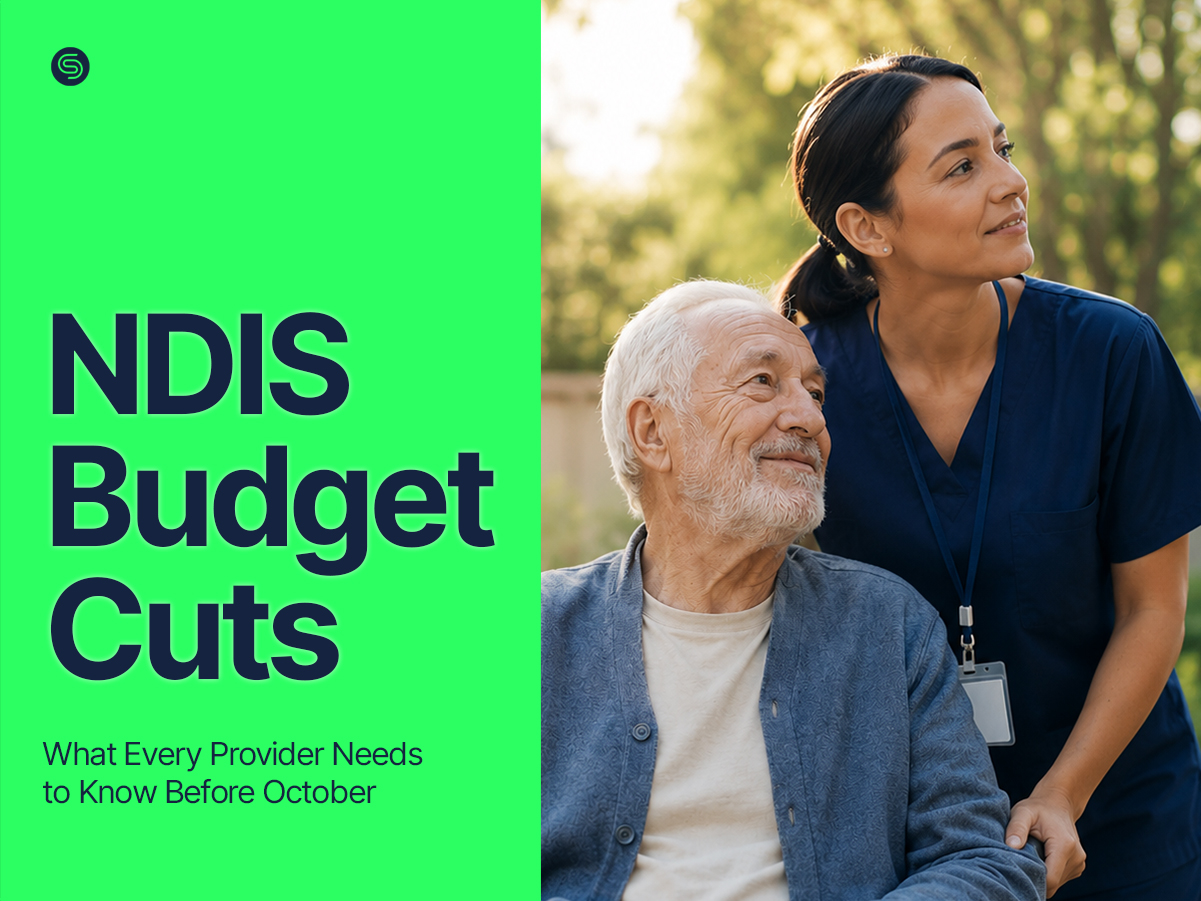
NDIS Budget Cuts 2026: What Every Provider Needs to Know Before October
The October 2026 funding changes aren't coming — they're already decided. Here's what's being cut, who's affected, and exactly what your organisation needs to do right now.
You've heard the noise. Another round of NDIS reforms. Another wave of policy announcements. Another reason to feel like the ground is shifting beneath your feet.
But the October 2026 budget cuts are different. These aren't consultations or proposals — they are confirmed changes that will directly reduce funding in the support categories that many providers build their entire service model around.
If your organisation delivers social, civic, and community participation supports — or capacity building daily activities — this article is your briefing. Read it, share it with your team, and act on it before the cuts hit.
What the NDIS Is Actually Cutting — And Why
Starting 1 October 2026, two of the NDIS's most widely used support categories will face budget reductions:
- Social, civic, and community participation — the supports that fund group activities, community engagement, and social inclusion programmes
- Capacity building daily activities — the supports that help participants develop life skills, independence, and confidence in everyday routines
These reductions are part of the Federal Government's broader push to improve the sustainability of the NDIS. With scheme costs continuing to rise sharply and participant numbers already being wound back from 760,000 toward 600,000 by 2030, the government is cutting in areas it considers lower-priority relative to core disability supports.
The official rationale centres on three goals: ensuring long-term NDIS sustainability, improving efficiency in fund allocation, and shifting toward more individualised, outcome-driven support plans.
Whether or not you agree with that framing, the practical reality for providers is simple: less money is coming in for some of your most commonly delivered services. Knowing exactly what that means for your operation — before October — is the difference between adapting ahead of the curve and scrambling to catch up after it.
Who Gets Hit Hardest: Participants, Families, and Providers
Participants
For many NDIS participants, community participation and capacity building aren't optional extras — they are the supports that make independence possible. Group programmes build social connections. Skills training builds confidence. Without adequate funding for these categories, participants risk losing access to the very activities that keep them engaged, developing, and connected.
Reduced funding could mean:
- Fewer community involvement opportunities and group programme slots
- Less access to social interaction and peer connection
- Slower skill development for participants working toward greater independence
- Increased pressure on informal support networks — families and carers — to fill the gaps
Families and Carers
When funded supports shrink, unpaid carers pick up the difference. Families who rely on NDIS-funded programmes to give participants meaningful engagement — and to give themselves breathing room — will likely face increased caring responsibilities and the emotional and financial strain that comes with them. Carer burnout is not a personal failing; it is a structural consequence of underfunded systems, and October 2026 risks making it worse.
Service Providers
For NDIS providers, the impact is both financial and operational. Services that are currently viable at existing price guide rates may become unsustainable when participant budgets for these categories are reduced. Providers heavily concentrated in community participation and capacity building will face direct revenue pressure — on top of the rising wages, supply costs, and compliance burdens already straining the sector.
The message is clear: providers who haven't reviewed their service mix and financial exposure ahead of October 2026 are leaving themselves vulnerable.
What This Means for Your Service Model
The October 2026 cuts are not an isolated event. They are one piece of a broader reform agenda that is fundamentally reshaping what the NDIS funds, how it funds it, and who qualifies for what level of support.
For service providers, the question isn't just "how much less will we receive per plan?" — it's "is our current model built to survive in the scheme as it's being redesigned?"
Here's where most providers need to focus:
Review your participant mix immediately. If a significant proportion of your current participants rely heavily on social participation or capacity building budgets, model out the revenue impact of a 10–20% reduction in those category allocations. Run the numbers before October, not after.
Diversify what you offer. Sole reliance on any single NDIS support category is a structural risk. Providers exploring Supported Independent Living, specialist disability accommodation, allied health services, or capacity building supports in employment and education are building in the redundancy that protects them when one revenue stream tightens.
Engage with your participants now. Participants whose plans include affected supports will be receiving updated information from the NDIA. Proactive communication from you — explaining what the changes mean for their services and what options remain — builds trust and reduces the risk of losing clients who feel uninformed and unprotected.
Stay connected to the advocacy conversation. Disability advocacy groups are actively seeking provider voices in consultations about how these cuts are implemented. The providers who participate in these forums have more influence over the detail of the changes — and more visibility into what's coming next.
The Hidden Risk: Administration Collapse Under Pressure
When funding tightens, one of the first places providers feel it is in their back-office operations. Teams are asked to do more with less, processes that worked fine at one scale start to break under pressure, and compliance obligations don't shrink just because revenue does.
The October 2026 changes will likely increase administrative complexity for providers. Participants will have more questions. Plans will require more careful review. Billing for affected categories will need tighter accuracy to avoid claim rejections at precisely the moment providers can least afford delays.
This is exactly the environment where disorganised operations become catastrophic. And it's where Dayspring Care's DSC platform gives providers a measurable advantage.
DSC centralises participant file management — care plans, individual support plans, risk management plans, and funding details — so your team isn't hunting across shared drives and email threads for the information they need when a participant's budget changes. When plan reviews happen en masse following the October cuts, having every participant's records audit-ready and accessible in one place is not a small thing. It's the difference between managing the transition and being overwhelmed by it.
Automated billing workflows in DSC also reduce the risk of claim errors during a period when the NDIA's payment systems are themselves undergoing changes. Getting claims right the first time, every time, protects your cash flow when margins are already tightening.
Three Practical Steps Providers Should Take Right Now
1. Conduct a Service Viability Review
Before October, map out precisely which of your current services draw on the affected support categories, and what proportion of your total revenue they represent. This is your provider risk assessment — the financial health check that tells you where you're exposed and how urgently you need to act.
Providers using DSC can pull this analysis directly from the platform's built-in reporting tools, rather than manually reconciling spreadsheets and billing records. Real-time visibility into your service mix and funding sources is one of the practical advantages of having all your operations in one system.
2. Explore and Expand Your Revenue Diversification
The providers who will navigate the October 2026 cuts most effectively are those who aren't dependent on any single funding stream. Consider whether your organisation is positioned to expand into:
- Supported Independent Living (SIL) — a high-demand, relatively stable funding category
- Specialist Disability Accommodation (SDA) — infrastructure-intensive but insulated from plan-level budget fluctuations
- Allied health services — particularly behaviour support, occupational therapy, and speech pathology, where demand consistently outpaces supply
- Foundational Supports — the new tier sitting alongside the NDIS, designed to serve people who don't qualify for the scheme itself
True diversification of revenue streams isn't about spreading yourself thin — it's about building a portfolio of services where the risk isn't all concentrated in one place.
3. Build Participant and Carer Communication Protocols
The participants and families most affected by these cuts will be anxious. They may not fully understand what the changes mean for their plans. Providers who proactively communicate — clearly, early, and with genuine care — will retain those relationships. Those who go quiet will lose them.
Set up a communication plan now: how you'll notify affected participants, what your frontline staff will say when asked about the cuts, and how you'll support participants in accessing plan reviews if their current budgets are no longer adequate for the supports they need.
Looking Ahead: Adapting to a Leaner, More Complex NDIS
The October 2026 budget cuts are a signal, not just a standalone event. The direction of NDIS policy is toward a leaner scheme with tighter eligibility, reduced budgets in non-core categories, and a stronger emphasis on measurable outcomes.
For providers, the appropriate response isn't panic — it's strategic adaptation. The organisations that will continue delivering quality supports in 2027 and 2030 are the ones building leaner operations, more diversified service portfolios, and stronger systems for managing participants and compliance without ballooning their overhead.
The government's commitment to monitoring these changes is real, and the advocacy community's scrutiny will be intense. That means there is still scope to influence how the cuts are implemented at the detail level — and real value in staying engaged with NDIS consultation processes rather than simply reacting to what arrives.
The Bottom Line: Preparation Is the Only Viable Strategy
The NDIS is changing. The October 2026 cuts are confirmed. Participants will have less funding for community participation and capacity building. Providers built around those categories will feel the revenue pressure.
But change, even unwelcome change, creates space for the prepared.
Providers who review their exposure now, diversify their service offerings, strengthen their internal systems, and communicate proactively with their participants will not only survive October 2026 — they will emerge as the organisations other providers wish they had built.
The sector needs you to stay viable. Your participants need you to stay open. Both of those things start with the same decision: prepare now, not later.
Take Control of Your Operations Before the October Cuts Hit
The single most controllable factor in how your organisation handles the October 2026 changes is how well your operations are running today. Disorganised rostering, manual billing, scattered participant records, and reactive compliance are liabilities in a stable environment. In a funding-cut environment, they are existential risks.
Dayspringcare Software is the cloud-based, end-to-end management platform built specifically for NDIS and home care providers — and it was designed for exactly the operational pressure the sector is now facing.
With DSC, your organisation can:
- Stay audit-ready — Centralised, up-to-date participant files accessible by authorised staff from any device
- Streamline billing — Accurate NDIS claims submitted faster, with fewer rejections and payment delays
- Stabilise your workforce — Smart rostering that reduces last-minute gaps and support worker burnout
- Manage with confidence — Real-time reporting and analytics that give you genuine visibility into your financial and operational health
- Scale securely — Australian-hosted data, Privacy Act compliant, with the flexibility to grow without breaking your systems
Whether you're running a small team navigating your first reform cycle or a registered provider managing complex, multi-site operations — DSC gives you the operational foundation to adapt and keep delivering quality care, regardless of what the NDIS throws at you next.
Start your free trial at dayspringcare and walk into October 2026 with your operations ready.
Stay informed on NDIS policy changes, funding updates, and provider strategies — the sector moves fast, and being ahead of it is the best competitive advantage you have.