Preparing for Your NDIS Audit Successfully
Does the word "compliance" make your heart race?
NDIS auditors aren't looking for perfection. They're looking for evidence that your daily actions match your written policies. Here's how to make sure yours do
For many providers, an ndis audit feels like a trap, but it is actually designed as a professional health check for your practice. This process simply validates that the high-quality care you deliver to participants is backed by safe internal systems.
NDIS approved auditors function less like investigators and more like quality assurance partners. In practice, they look for evidence that your daily actions align with the Quality and Safeguarding Framework, ensuring your paperwork matches your service delivery.
Success starts with this shift in perspective. Treating compliance as a continuous journey rather than a one-time exam minimizes business disruption and turns a mandatory requirement into a competitive advantage.
Certification vs. Verification: Identifying Your Specific Audit Pathway and Costs
The specific check-up your business needs depends entirely on the services you provide, technically called "Registration Groups." If you deliver lower-risk support, like gardening or cleaning, the regulations don't require the same intense scrutiny as a provider administering medication. This risk-based approach ensures that the ndis audit cost and effort match the complexity of care you deliver.
Once you select your groups in the portal, the system assigns one of two pathways:
- Verification: Designed for lower-risk services. An ndis auditor reviews your documents remotely (a "desktop audit") to meet verification audit requirements, checking for valid insurance, qualifications, and incident management processes.
- Certification: Required for higher-risk groups like Daily Personal Activities or Behaviour Support. This involves a document review plus an "onsite audit," where auditors interview staff and participants to ensure ndis certification audit standards are active in daily practice.
Knowing your pathway is essential for budgeting, as Verification is significantly cheaper and faster than the multi-stage Certification process. Regardless of the complexity, success ultimately comes down to proving you do what you say you do. The most effective way to manage this is by organizing your documentation logically.
The 3-Pile Evidence Strategy: Organizing Your NDIS Practice Standards Compliance
Staring at a blank NDIS Practice Standards compliance checklist can feel paralyzing, but audits are rarely about creating entirely new mountains of paperwork. Usually, the task is simply organizing what you already have into a structure the auditor understands.
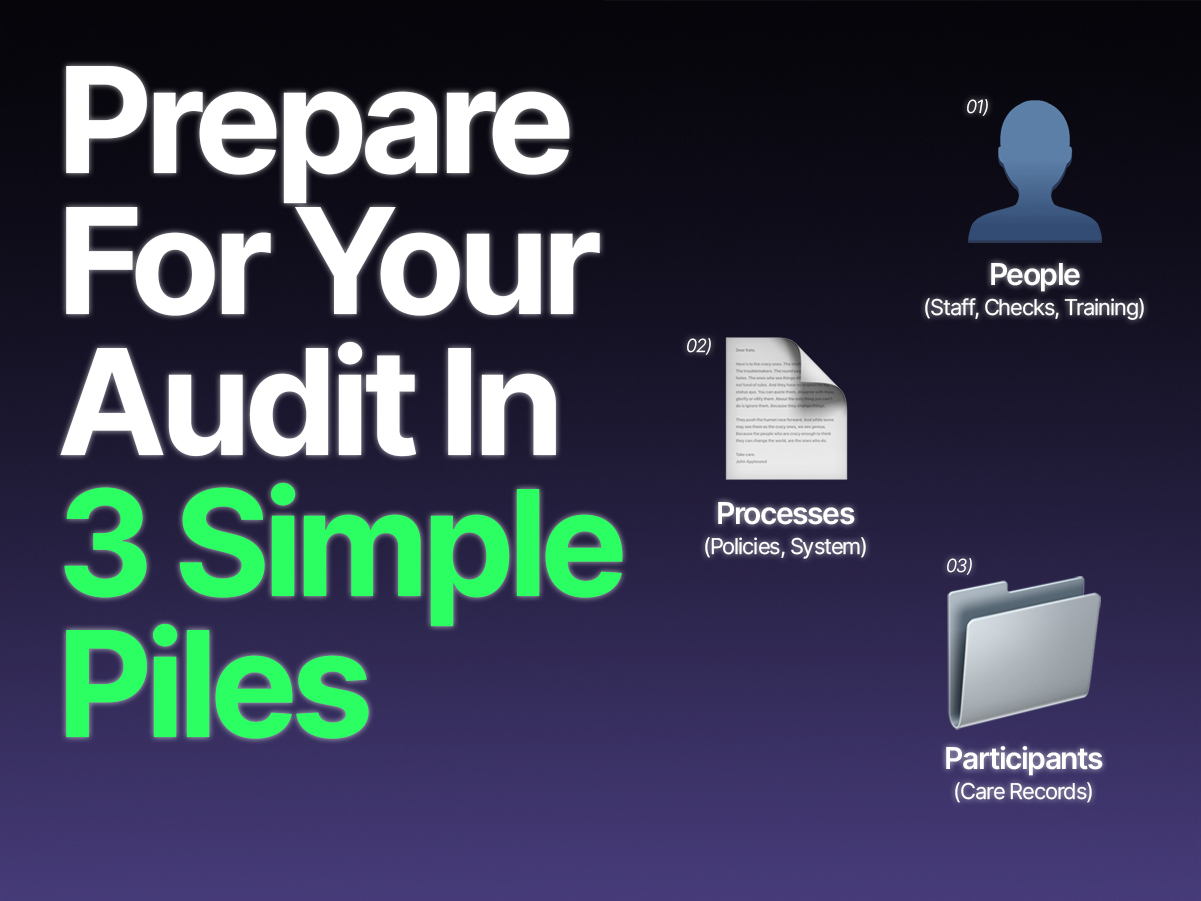
Instead of viewing your business as one giant folder, simplify your preparation by sorting your documentation into three logical buckets: People, Processes, and Participants.
To satisfy the required evidence for NDIS Quality and Safeguards Commission, you need to prove that your business is safe and consistent across these three specific areas:
- People: Evidence that your staff are qualified, trained, and safe to work (e.g., qualifications, clearances).
- Processes: Your "Instruction Manual"—the written policies describing how you handle incidents, complaints, or feedback.
- Participants: The files showing actual service delivery (e.g., intake forms, care plans, shift notes).
Take the "People" category as a prime example of evidence versus simple documentation. Having a resume on file is documentation, but implementing NDIS worker screening checks correctly creates verifiable evidence. It isn't enough to just hold a copy of a clearance card; you must link the employee to your business inside the NDIS Worker Screening Database. This digital link provides the auditor with indisputable proof that you vetted your staff before they ever entered a client’s home.
For the final pile, your participant record management systems should tell a clear story without you needing to speak. If an auditor pulls a random client file, they should be able to trace the journey from the initial agreement to the most recent daily note, confirming that your actual care matches your written promises.
This narrative must hold up under pressure, which requires testing your systems before the official review.
Conducting a 'Mock Exam': Gap Analysis and the Self-Assessment Tool
Waiting for the official audit to discover mistakes is stressful, but you can control the outcome by running a dress rehearsal first. This is where the NDIS self-assessment tool for providers becomes your roadmap.
Instead of guessing if your compliance is sufficient, this tool acts like an open-book test, allowing you to grade your own performance against the standards before an external auditor ever steps foot in your office.
Once you have your evidence organized, you perform a gap analysis for NDIS registration renewal. Think of this as checking your ingredients before cooking; you are simply comparing what your policy says you do against what actually happens during a shift.
If you find a mismatch, you have identified a "non-conformity." Don't panic—finding common NDIS audit non-compliance issues yourself is a victory. A missing date on a single form is usually a "Minor" issue (a quick fix), whereas a complete lack of mandatory worker screening represents a "Major" issue (a safety risk that must be solved immediately).
To systematize this review, use this simple internal audit template for NDIS providers:
- Select a Standard: Pick one specific topic, such as "Complaints Management."
- Review Policy: Read your own rules to understand exactly what you promised to do.
- Check Reality: Pull three random participant files to verify if those steps were actually taken.
- Close the Gap: If the file doesn't match the rule, retrain staff or update the form immediately.
With gaps identified and closed, the next step is navigating the human element of the process: the interview and site visit.
Navigating Audit Day: What to Expect During Interviews and Site Visits
Facing an auditor can feel intimidating, but remember their role is simply to verify that your quality management system for NDIS compliance is active, not just a binder sitting on a shelf.
Whether this is your initial certification or a standard NDIS mid-term audit, the auditor wants to see that your team understands the rules they follow every day. They aren't looking for staff to recite legislation; they want to hear authentic examples of how you support your participants safely and respect their choices.
Your support workers are often the best proof of your compliance, so brief them on the basics without forcing them to memorize scripts. Auditors typically assess your team's grasp of developing NDIS incident management policies by asking practical, scenario-based questions.
Expect inquiries like:
- "What specific steps would you take immediately if a participant fell during a shift?"
- "Where do you look to find the specific goals for the participant you are working with today?"
- "How do you officially report a concern if a family member tells you they are unhappy with the service?"
During the site visit or remote screen-share, the auditor will look for consistency between these answers and your records. If you know what to expect during a mid-term NDIS audit, you know they might ask to see a specific file mentioned in an interview to check if the progress notes match the worker's story.
If they find a discrepancy, they may issue a Corrective Action Plan (CAP), which is essentially a formal roadmap to fix the gap before your next review.
From Stress to Success: Building an 'Always Ready' Compliance Culture
Transforming your documentation into a daily habit shifts you from panic mode to confidence. By maintaining a simple quality management system for NDIS compliance, you ensure that passing an audit is just a byproduct of good business rather than a stressful disruption.
While finding the cheapest NDIS auditor helps your budget, consistent preparation secures your long-term peace of mind.
Start your continuous improvement journey today:
- Commit to a 30-day "Audit Ready" challenge by reviewing one participant file every Friday against your NDIS audit checklist to identify and fix gaps immediately.
Build an Audit-Ready System—Not Last-Minute Fixes
NDIS audits shouldn’t rely on rushed preparation or scattered documents.
This is where a lot of providers fall down — they have the documents but they're scattered across email, shared drives, and paper files. DSC keeps all three piles in one place.
See how DSC keeps your audit prep simple
Book a demo today.